Scars from past accidents, surgeries, burns, or trauma are more than just physical marks on the body—they are persistent reminders of difficult events that can alter your confidence. While completely erasing a deep scar is medically challenging, modern dermatosurgery and laser technologies make it entirely possible to reconstruct, remodel, and minimize them significantly.
At our clinic, we specialize in advanced scar reconstruction. We don't just treat the surface color; we completely remodel the damaged, hardened tissue underneath to restore your skin's natural flexibility, smoothness, and uniform appearance.
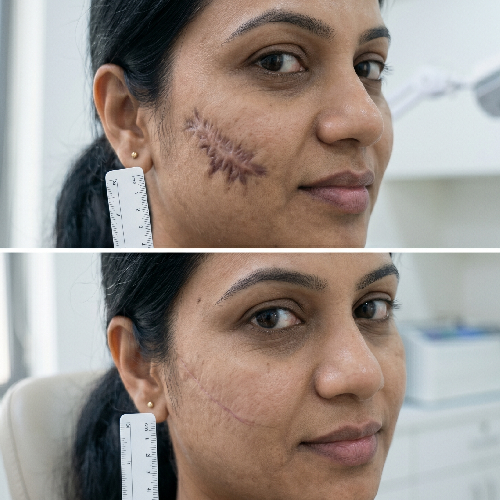

Every scar has a unique structural blueprint, and our interventions are tailored to how your tissue healed:
Our Advanced Reconstruction Techniques
To achieve the best aesthetic outcomes, our dermatologist often creates a multi-layered, customized protocol utilizing these advanced modalities:
|
Treatment Modality |
How It Works |
Ideal For |
|
Fractional Laser Resurfacing |
Creates microscopic thermal columns in the skin, forcing old scar fibers to break up and replace themselves with supple, new collagen. |
Surgical marks, rigid textures, and burn scars |
|
Surgical Revision & Z-Plasty |
Carefully excising the old scar and re-stitching it with ultra-fine, microscopic suturing techniques along natural skin folds. |
Wide, jagged, or distorted accidental scars |
|
Intralesional Remodeling |
Injecting specialized targeted medications directly into thick, raised scars to stop abnormal collagen overproduction. |
Active keloids and thick hypertrophic scars |
|
Skin Grafting & Micro-Punching |
Replacing severely damaged, fibrous scar sections with tiny pieces of healthy skin tissue from a hidden donor site. |
Stable, non-yielding deep scars |
[ Step 1: Structural Assessment ] ➔ [ Step 2: Custom Tissue Remodeling ] ➔ [ Step 3: Targeted Micro-Healing ]
Scar tissue behaves entirely differently from normal skin. Attempting generic laser treatments or applying basic creams won't change its structure. True scar reconstruction requires a dermatologist's deep understanding of tissue anatomy and healing dynamics to safely alter the scar pattern and blend it naturally into the surrounding skin.
 Medical experts Women's health Skin Care Cardiac care
Medical experts Women's health Skin Care Cardiac care
Medical experts Women's health Skin Care Cardiac care
Medical experts Women's health Skin Care Cardiac care
Medical experts Women's health Skin Care Cardiac care
Medical experts Women's health Skin Care Cardiac care
Medical experts Women's health Skin Care Cardiac care